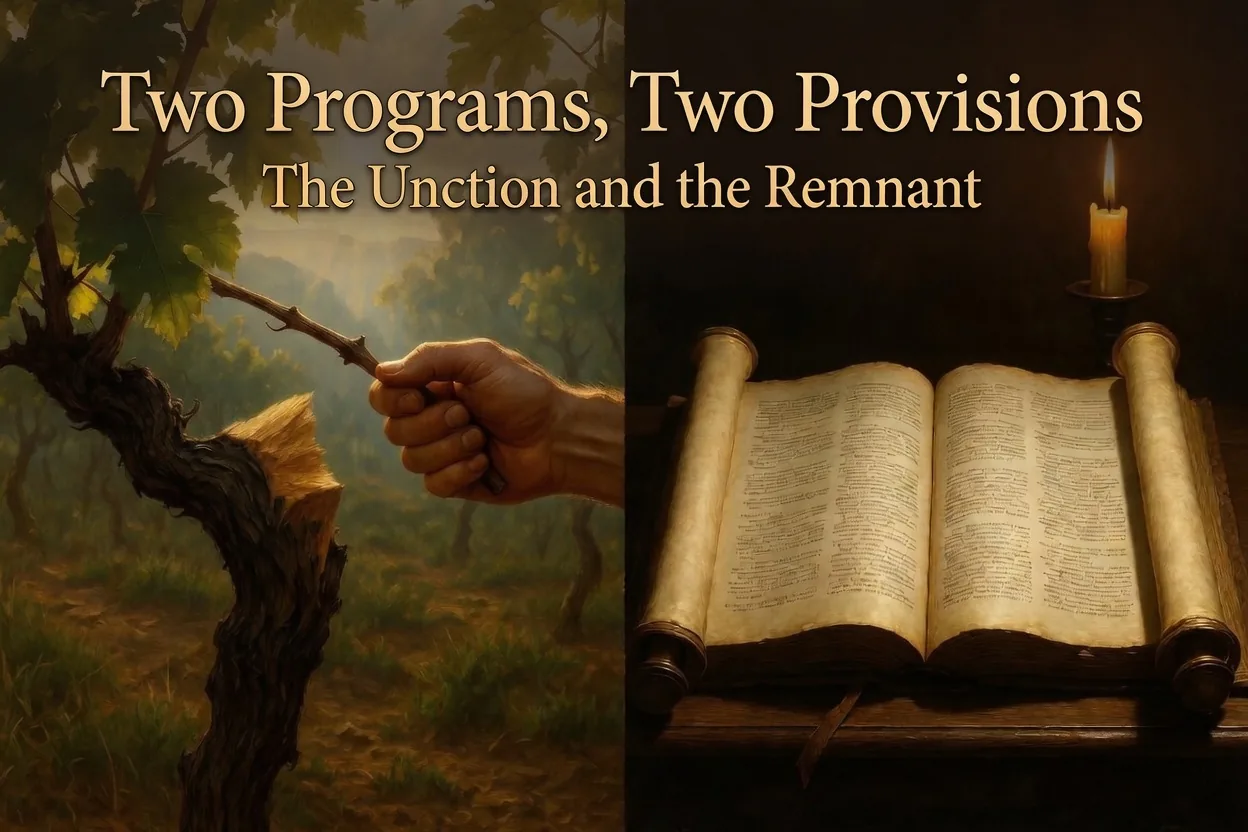
"But ye have an unction from the Holy One, and ye know all things." (1 John 2:20)
There is a verse in the Bible that almost no Christian actually believes, even when they claim it for themselves. John says plainly, "ye know all things." Stop and ask whether that is your experience. Do you know all things? Does any believer you have ever met know all things? The honest answer is no — and that alone should tell us that something has gone wrong with how we are reading this verse.
There are two options. Either John was wrong, or we are wrong about who John was talking to. The Scriptures do not err. That leaves us with the second option, and right division opens the door to the answer. John was not writing to the Body of Christ. He was writing to the believing Jewish remnant living in what he called "the last time," with the Antichrist on the horizon and seducers already at work trying to draw them away from the truth. The unction he describes is not a general Christian experience — it is a specific provision of the New Covenant given to believing Israel, rooted in promises made through Jeremiah, Ezekiel, and Joel, and confirmed by the Lord Jesus Christ to His Jewish disciples in the upper room. Failing to recognize this leads directly to confusion, false teaching, and the robbery of both Israel's promises and the Body of Christ's distinct position in grace.
Who Is the "Ye"?
The first question we must answer when we read any verse is: who is being spoken to? The letter of 1 John does not begin with a greeting naming the audience the way Paul's epistles do, but the context makes the audience unmistakable if we read carefully.
In 1 John 2:18–19, John writes: "Little children, it is the last time: and as ye have heard that antichrist shall come, even now are there many antichrists; whereby we know that it is the last time. They went out from us, but they were not of us; for if they had been of us, they would no doubt have continued with us: but they went out, that they might be made manifest that they were not all of us."
John says it is the last time. The last time before what? He tells you — the coming of the Antichrist. John's readers are living in an eschatological framework tied to the arrival of the final enemy of Israel, the man of sin who will demand worship in the tribulation and demand that Israel deny the Christ. That is not the framework Paul ever puts the Body of Christ in. Paul's epistles do not warn us to endure until the Antichrist is defeated. They do not place us in a time called "the last time" in this sense. Our hope is upward — "For our conversation is in heaven; from whence also we look for the Saviour, the Lord Jesus Christ" (Philippians 3:20). John's readers are earthbound, waiting for the appearing of Christ at the second advent.
The language about those who "went out from us" connects directly to the seven churches in the book of Revelation, which are not Body-of-Christ assemblies but letters to believing Jewish remnant congregations during the tribulation period. To the church in Smyrna, Jesus says: "I know the blasphemy of them which say they are Jews, and are not, but are the synagogue of Satan" (Revelation 2:9). To Philadelphia: "Behold, I will make them of the synagogue of Satan, which say they are Jews, and are not, but do lie" (Revelation 3:9). Those who "say they are Jews and are not" are precisely the antichrists John describes — those who deny the Christ while claiming to be of Israel. John's audience knows exactly what he means because they are living inside that framework.
The "ye" in verse 20 are the believing Jewish remnant in the last time — not the Body of Christ.
The Holy One Is the Holy One of Israel
The unction John speaks of comes "from the Holy One." That title is not incidental and it is not generic. The phrase "the Holy One" or "the Holy One of Israel" appears fifty-one times in the Scriptures, overwhelmingly in the prophets, and it consistently identifies the God of Israel in covenant relationship with His nation.
Isaiah uses it throughout his prophecies of Israel's judgment and restoration: "the remnant of Israel, and such as are escaped of the house of Jacob, shall no more again stay upon him that smote them; but shall stay upon the LORD, the Holy One of Israel, in truth" (Isaiah 10:20). Ezekiel uses it in the context of God's vindication of His holy name among His people: "So will I make my holy name known in the midst of my people Israel; and I will not let them pollute my holy name any more: and the heathen shall know that I am the LORD, the Holy One in Israel" (Ezekiel 39:7).
When Peter preaches in Acts 3 and charges the men of Israel with their rejection of Christ, he uses the same title: "But ye denied the Holy One and the Just, and desired a murderer to be granted unto you" (Acts 3:14). To deny that Jesus is the Christ is to deny the Holy One — the Holy One of Israel. That is exactly what John says the antichrists are doing in 1 John 2:22: "Who is a liar but he that denieth that Jesus is the Christ? He is antichrist, that denieth the Father and the Son."
The whole framework is Israelite. The Holy One is Israel's God. The denial being warned against is Israel's historic denial of their Messiah. The unction comes from the God of Israel to His believing people. This is not the language of the Body of Christ, where there is neither Jew nor Greek and where Paul never once uses the title "the Holy One" to describe God in his epistles.
The Unction and What It Actually Does
With the audience established, we can read what the unction actually provides. John expands on it in verse 27: "But the anointing which ye have received of him abideth in you, and ye need not that any man teach you: but as the same anointing teacheth you of all things, and is truth, and is no lie, and even as it hath taught you, ye shall abide in him."
Three things stand out. First, the anointing abides in them — it is a resident presence of the Spirit within the believing remnant. Second, the anointing teaches them all things — it is the source of their knowledge, not human instruction. Third, the anointing leads them to abide in him — it is the means by which they endure and remain in Christ through what John has just called the last time, with seducers actively working to draw them away.
John is not making a vague spiritual claim. He is connecting the remnant to a specific promise. Verse 26 gives the purpose: "These things have I written unto you concerning them that seduce you." There is a real threat. People are actively working to pull the remnant away from the truth that Jesus is the Christ. The unction is their defense — because the anointing that teaches them all things is also what enables them to recognize a lie when they hear it. You cannot be seduced away from what you know, and they know all things through the Spirit who abides within them.
This is also deeply conditional language. John says in verse 24: "Let that therefore abide in you, which ye have heard from the beginning. If that which ye have heard from the beginning shall remain in you, ye also shall continue in the Son, and in the Father. And this is the promise that he hath promised us, even eternal life." The promise of eternal life is tied to continuing. If they abide, they continue. If they do not — the word is left hanging. This is the framework of the remnant's program, not the Body of Christ's, where we are sealed unto the day of redemption (Ephesians 4:30) with no conditional abiding required.
John concludes the section with: "And now, little children, abide in him; that, when he shall appear, we may have confidence, and not be ashamed before him at his coming." The hope is the appearing of Christ — the second advent. The concern is not being ashamed before Him when He comes to earth. That is not the Body of Christ awaiting the rapture. That is the believing remnant of Israel enduring through the tribulation and standing before their King at His return.
The New Covenant Is the Source
Where did John get this? He did not invent it. He is pointing the remnant to God's long-standing covenant promise to the house of Israel. Seven hundred years before John wrote, God spoke through Jeremiah:
"31 Behold, the days come, saith the LORD, that I will make a new covenant with the house of Israel, and with the house of Judah... 33 But this shall be the covenant that I will make with the house of Israel; After those days, saith the LORD, I will put my law in their inward parts, and write it in their hearts; and will be their God, and they shall be my people. 34 And they shall teach no more every man his neighbour, and every man his brother, saying, Know the LORD: for they shall all know me, from the least of them unto the greatest of them, saith the LORD." (Jeremiah 31:31–34)
Read verse 34 again slowly. "They shall teach no more every man his neighbour." Why? "For they shall all know me, from the least of them unto the greatest of them." That is the same promise John echoes in 1 John 2:27 — "ye need not that any man teach you." John is not departing from the prophetic program. He is showing the remnant that they are living in its beginning fulfillment. The unction is the New Covenant beginning to operate in the believing remnant of Israel. The Spirit is writing the knowledge of God into their hearts, just as God promised through Jeremiah. When John says "ye know all things," he is pointing back to "they shall all know me, from the least of them unto the greatest."
The book of Hebrews, written to the same Hebrew audience, quotes Jeremiah 31 in full and applies it explicitly: "And they shall not teach every man his neighbour, and every man his brother, saying, Know the Lord: for all shall know me, from the least to the greatest. For I will be merciful to their unrighteousness, and their sins and their iniquities will I remember no more" (Hebrews 8:11–12). And again in Hebrews 10:15–17: "The Holy Ghost also is a witness to us: for after that he had said before, This is the covenant that I will make with them after those days, saith the Lord, I will put my laws into their hearts, and in their minds will I write them." The Holy Ghost is the witness. He is the one writing God's law in their hearts and minds. He is the unction. The unction is the New Covenant Spirit.
Ezekiel confirms the same truth with different language: "And I will put my spirit within you, and cause you to walk in my statutes, and ye shall keep my judgments, and do them" (Ezekiel 36:27). The Spirit causes them to walk in the statutes. This is not the Body of Christ's program. Paul never says the Spirit causes the Body of Christ to keep the Mosaic statutes. Paul says "ye are not under the law, but under grace" (Romans 6:14). These are two entirely different provisions for two entirely different programs.
Joel's prophecy ties it together from another angle: "And it shall come to pass afterward, that I will pour out my spirit upon all flesh; and your sons and your daughters shall prophesy, your old men shall dream dreams, your young men shall see visions" (Joel 2:28). The "all flesh" in context is all of Israel — the universalizing of the Spirit's presence among the covenant nation, from the greatest to the least. Jeremiah said "from the least of them unto the greatest of them." Joel says it will cover all flesh — sons, daughters, old men, young men, servants, handmaids. These are the same promise. The unction is the poured-out Spirit of Joel's prophecy beginning to be fulfilled in believing Israel.
Peter stood up on the day of Pentecost and declared: "This is that which was spoken by the prophet Joel" (Acts 2:16). The outpouring on that day was the beginning of the fulfillment of Joel's prophecy and, with it, the beginning of the New Covenant's unction in the believing remnant. John, writing later, can say to that same believing Jewish remnant: you have already received this. The unction abides in you. You are the first-fruits of what Jeremiah and Joel and Ezekiel were pointing toward.
The Comforter in John 14–16 Is the Same Spirit
The Lord Jesus Christ Himself was the one who promised the unction to His Jewish disciples, and He did it in the upper room during His final hours with them. In John 14:15–17, after telling them to keep His commandments, He says: "And I will pray the Father, and he shall give you another Comforter, that he may abide with you for ever; Even the Spirit of truth; whom the world cannot receive, because it seeth him not, neither knoweth him: but ye know him; for he dwelleth with you, and shall be in you."
These are His twelve Jewish disciples — the foundation of Israel's restored nation, the ones He told would sit on twelve thrones judging the twelve tribes (Matthew 19:28). He is not speaking to the Body of Christ, which did not yet exist. He is promising Israel's believing remnant their Comforter — the Spirit who would abide with them forever and be in them. This is the unction.
In John 14:25–26 He makes the teaching function explicit: "But the Comforter, which is the Holy Ghost, whom the Father will send in my name, he shall teach you all things, and bring all things to your remembrance, whatsoever I have said unto you." The Comforter shall teach you all things. Compare that with 1 John 2:20 — "the anointing teacheth you of all things." These are not independent promises. John is pointing the remnant back to what Jesus promised them in the upper room. The unction they have received is the fulfillment of what the Lord promised the eleven that night.
John 16:13 adds: "Howbeit when he, the Spirit of truth, is come, he will guide you into all truth: for he shall not speak of himself; but whatsoever he shall hear, that shall he speak: and he will shew you things to come." He will guide them into all truth. He will show them things to come. This is the all-encompassing knowledge that John describes — the unction that teaches all things. The Spirit of truth is the unction. Jesus promised it to Israel's remnant. John confirms they have it. And it functions exactly as the New Covenant said it would: writing the knowledge of God in their hearts, enabling them to know all things, empowering them to abide.
The Vine and Branches Confirms the Framework
The vine and branches passage in John 15 belongs to the same upper room discourse and the same audience, and it seals the conditional character of the unction's framework. Jesus says: "I am the true vine, and my Father is the husbandman. Every branch in me that beareth not fruit he taketh away: and every branch that beareth fruit, he purgeth it, that it may bring forth more fruit" (John 15:1–2).
The first thing to notice is who is doing the taking away. Not men. Not tribulation. Not the world. The Father. He is the husbandman — the one tending the vine. He is the one who removes the fruitless branch. That is not a passive process. It is a sovereign act of the Father on a branch that was genuinely in the vine.
Was the fruitless branch actually in the vine? Yes. Jesus says "every branch in me that beareth not fruit." In me. These were not false professors or people who were never truly in Christ in the first place. They were branches in the vine — genuine, living connections to the true vine — that failed to produce fruit. The Father took them away. This is a real and sobering removal from a real position.
Verse 6 extends the warning with the full consequence: "If a man abide not in me, he is cast forth as a branch, and is withered; and men gather them, and cast them into the fire, and they are burned." The branch does not abide. It is cast forth — and again, verse 2 has already told us who does the casting: the Father, the husbandman. The mention of men gathering and burning the branch is simply the natural extension of the illustration — it is what you do with a dead branch that has been cut from a vine. The point is not that men play a theological role in the judgment. The point is what the Father's act of removing the branch leads to: a branch severed from the vine withers, and a withered branch is good for nothing but the fire. The branch is no longer in the vine, no longer in Christ, no longer connected to the life that comes from the root. That is the gravity of what the Father as husbandman does when a branch fails to abide.
This is the gravity the unction is designed to counteract. The believing remnant in the last time faces fierce seduction — people actively working to draw them away from the truth that Jesus is the Christ (1 John 2:26). The temptation is to deny the Son under pressure, to stop abiding in the truth heard from the beginning. The Father, as the husbandman, will remove those who yield to that seduction. They will be cast forth as a branch — no longer in the vine. The unction is what enables the remnant to stand and abide, because the anointing teaches them all things and is truth and is no lie (1 John 2:27). Without the unction, they would not be able to distinguish truth from the lie. With the unction, they can abide. But the abiding is still their responsibility, and failing it has consequences the Father Himself enforces.
None of this is unique to John 15. The tree-fruit-fire imagery runs as a consistent thread through everything Christ said to Israel in His earthly ministry, and recognizing that thread confirms that John 15:6 is kingdom language addressed to Israel — not a general warning to all Christians in all ages.
John the Baptist opened with it at the very start: "And now also the axe is laid unto the root of the trees: therefore every tree which bringeth not forth good fruit is hewn down, and cast into the fire" (Matthew 3:10). That was addressed to the Pharisees and Sadducees coming to his baptism — Israel's religious leaders. Same imagery: tree, fruit, hewn down, cast into fire.
Christ repeated it Himself in the Sermon on the Mount: "Every tree that bringeth not forth good fruit is hewn down, and cast into the fire" (Matthew 7:19). Again to Israel. The language of John 15:6 is not something new invented for the upper room — it is the final expression of a warning Christ had been giving His people all along.
The kingdom parables carry the same judgment framework. In the parable of the tares, Christ says: "As therefore the tares are gathered and burned in the fire; so shall it be in the end of this world. The Son of man shall send forth his angels, and they shall gather out of his kingdom all things that offend" (Matthew 13:40–41). In the parable of the net: "So shall it be at the end of the world: the angels shall come forth, and sever the wicked from among the just, and shall cast them into the furnace of fire" (Matthew 13:49–50). Kingdom parables, end of the age, gathering and fire. These are Israel's warnings about the judgment that will accompany the coming of the Son of man.
The consistency is the argument. Every time Christ used tree-fruit-fire imagery, He was warning Israel about the kingdom and its judgment. John 15:6 stands in that exact line. The vine and branches is not a departure from Christ's kingdom preaching to Israel — it is the culmination of it, spoken to His Jewish disciples in their final hours together before the cross.
The same body of teaching contains another warning that brings the point home even more sharply. In Luke 12:46, Christ tells His disciples a parable about a servant who knew his lord's will but stopped watching and began to behave badly while the master was away: "The lord of that servant will come in a day when he looketh not for him, and at an hour when he is not aware, and will cut him in sunder, and will appoint him his portion with the unbelievers." Matthew's account renders it: "And shall cut him asunder, and appoint him his portion with the hypocrites: there shall be weeping and gnashing of teeth" (Matthew 24:51). This servant was in the house. He had a position. He knew the master's will. And yet his portion is appointed with the unbelievers — placed among those who never believed. That is a genuine position genuinely lost. It is the same warning as the branch cast out of the vine, expressed in different terms, and it belongs to exactly the same prophetic-kingdom framework directed at Israel.
Paul never once uses this language for the Body of Christ. He never warns us that we could be appointed our portion with unbelievers or cut asunder by the Lord. He warns us not to grieve the Spirit. He warns us not to walk unworthily of our calling. But our position in Christ is never at risk of being reassigned to the company of unbelievers. We are sealed. We are complete. We are members of His body. All of this — the tree-fruit-fire warnings, the cast-forth branch, the portion appointed with unbelievers — belongs to the prophetic program, the remnant, and the last time. It was never meant for us.
This framework is entirely foreign to the Body of Christ's program. Not because we are better, but because the Father has dealt with us differently through the mystery. Paul never uses the vine and branches language for the Body of Christ. Paul never tells the Body of Christ that the Father will cast them forth if they fail to abide. Our position is not one of conditional abiding — it is completeness: "And ye are complete in him" (Colossians 2:10). We are sealed: "ye were sealed with that holy Spirit of promise" (Ephesians 1:13). We are seated: "hath raised us up together, and made us sit together in heavenly places in Christ Jesus" (Ephesians 2:6). The Father is not the husbandman removing fruitless members from the Body of Christ. Christ is the head of the body, and we are members of His body, of His flesh, and of His bones (Ephesians 5:30). That is a union, not a vine with removable branches. None of Paul's language for our position in Christ has conditions attached. The unction's framework is entirely different. The remnant must abide through persecution, seduction, and the fiery trials of the last time, with the Father watching as husbandman. We are sealed and complete in Him before any of that begins.
Peter's letters confirm the same remnant framework from another angle. He writes to the scattered Jewish remnant about faith tried with fire and glory received at the appearing of Christ: "That the trial of your faith, being much more precious than of gold that perisheth, though it be tried with fire, might be found unto praise and honour and glory at the appearing of Jesus Christ" (1 Peter 1:7). And: "when the chief Shepherd shall appear, ye shall receive a crown of glory that fadeth not away" (1 Peter 5:4). The glory comes at the appearing — the second advent. The same appearance John points to when he says "when he shall appear, we may have confidence, and not be ashamed before him at his coming" (1 John 2:28). Peter and John are operating in the same prophetic framework. They are both writing to the believing Jewish remnant.
The Body of Christ Knows in Part
Now let us go to Paul, because the contrast he draws settles any remaining question.
In 1 Corinthians 13:9–12, writing to the Body of Christ, Paul says: "For now we know in part, and we prophesy in part. But when that which is perfect is come, then that which is in part shall be done away... For now we see through a glass, darkly; but then face to face: now I know in part; but then shall I know even as also I am known."
We know in part. That is the polar opposite of what John says to the believing remnant — "ye know all things." Paul does not say the Body of Christ has an unction giving all knowledge. He says we know in part. We see through a glass, darkly. The full knowledge — knowing as we are known, face to face — is reserved for a future day. If the unction of 1 John 2:20 applied to the Body of Christ, then Paul's statement in 1 Corinthians 13 would be a flat contradiction. You cannot simultaneously know all things by an unction and know only in part. The contradiction disappears the moment you recognize that Paul and John are writing to two different groups under two different programs.
Paul Prays for Knowledge — He Does Not Announce It
The contrast goes deeper than one verse. Look at how Paul treats knowledge throughout his epistles for the Body of Christ. He prays for it. He does not announce it.
In Colossians 1:9–10: "For this cause we also, since the day we heard it, do not cease to pray for you, and to desire that ye might be filled with the knowledge of his will in all wisdom and spiritual understanding; That ye might walk worthy of the Lord unto all pleasing, being fruitful in every good work, and increasing in the knowledge of God."
Paul prays that they would be filled with the knowledge of God's will. He prays that they would increase in the knowledge of God. Why would he need to pray this if they already had an unction giving them all knowledge? Because they do not have that unction. The Body of Christ grows in knowledge. The remnant receives it through the unction. Growth versus gift — that is the distinction.
In Ephesians 1:17–18 Paul prays again: "That the God of our Lord Jesus Christ, the Father of glory, may give unto you the spirit of wisdom and revelation in the knowledge of him: The eyes of your understanding being enlightened; that ye may know what is the hope of his calling, and what the riches of the glory of his inheritance in the saints."
He prays that God would give them the spirit of wisdom and revelation. He prays that the eyes of their understanding would be enlightened. He prays that they would know their hope and their inheritance. John never prays for the remnant to receive the unction — they already have it. The contrast is stark and deliberate. Paul prays because the Body of Christ does not have the unction. The remnant has the unction already — received at Pentecost, abiding within them, teaching them all things.
Furthermore, the word translated "unction" in 1 John 2:20 does not appear once in Paul's thirteen epistles. Not once. Paul never uses it to describe anything given to the Body of Christ. If the unction was part of the Body of Christ's provision, Paul — the apostle whose epistles define our doctrine and practice — would have said so. His silence is meaningful.
The Command for the Body of Christ Is Study, Not Unction
When Paul tells Timothy and every member of the Body of Christ how to handle the word of God, he does not say: claim the unction and let it teach you all things. He says: "Study to shew thyself approved unto God, a workman that needeth not to be ashamed, rightly dividing the word of truth" (2 Timothy 2:15).
Study. Work. Rightly divide. These are active, effortful commands. They presuppose that the Body of Christ does not have an automatic teaching Spirit that renders human effort unnecessary. Quite the opposite — Paul tells Timothy to commit what he has learned to faithful men who will be able to teach others also (2 Timothy 2:2). We have a teaching ministry. We have pastors and teachers given to the Body for its edification (Ephesians 4:11–12). The teaching ministry in this dispensation is not an obsolete relic of an earlier age — it is commanded, because the Body of Christ does not have the unction that would make it unnecessary.
The remnant's experience was exactly what the New Covenant promised: no need for any man to teach his neighbour, because they shall all know the LORD. That promise will be completely fulfilled when the New Covenant reaches its full operation in the earthly kingdom. The Body of Christ's experience is entirely different: we grow in the knowledge of God through the diligent study and rightly dividing of the Scriptures, through teachers committed to Paul's gospel, and through prayer that God would enlighten the eyes of our understanding. That is not inferior — it is the provision appropriate to a people with a heavenly calling and a completed revelation.
Two Programs, Two Provisions
What 1 John 2:20 describes is not the universal experience of all Christians in all ages. It is the specific provision of the New Covenant given to believing Israel living in the last time, empowering them to know all things, to abide in Christ, and to endure through the seduction and persecution of the days before the second advent. It flows from Jeremiah 31 and Ezekiel 36 and Joel 2, was promised by Christ in John 14–16, was poured out at Pentecost, and was operative in the believing Jewish remnant to whom John wrote.
The Body of Christ, by contrast, operates under the mystery program — a program kept secret since the world began, with no prophetic precedent and no covenant framework. We do not have the unction. We have something described in entirely different terms: we are in Christ, sealed by the Spirit until the day of redemption, complete in Him, seated together in heavenly places. We grow in knowledge through study and prayer, guided by Paul's epistles as the doctrinal standard for this dispensation. We are not a branch in a vine that must abide — we are members of His body, of His flesh, and of His bones (Ephesians 5:30).
Paul never tells us we know all things. Paul tells us we know in part and that we need to study and to pray. Taking 1 John 2:20 and claiming its unction for the Body of Christ does not elevate us — it confuses us. It breeds false confidence, undermines the teaching ministry, and imports the framework of a program that is not ours. It also steals from believing Israel what belongs to them — the specific, covenanted provision of the Spirit that was prophesied for their program and will be fully operative when their national covenant is complete.
Right division keeps both programs intact. Israel's unction is real, its basis is the New Covenant, and its full expression awaits the kingdom. The Body of Christ's provision is equally real — sealed, complete, and heavenly — and its full expression awaits the redemption of the body. Let each program speak for itself, and let us be content with what Paul, our apostle, has given us.
"Study to shew thyself approved unto God, a workman that needeth not to be ashamed, rightly dividing the word of truth." (2 Timothy 2:15)
© 2026 Edward R. Cross


Comments
No comments yet. Be the first to share your thoughts.
Leave a comment