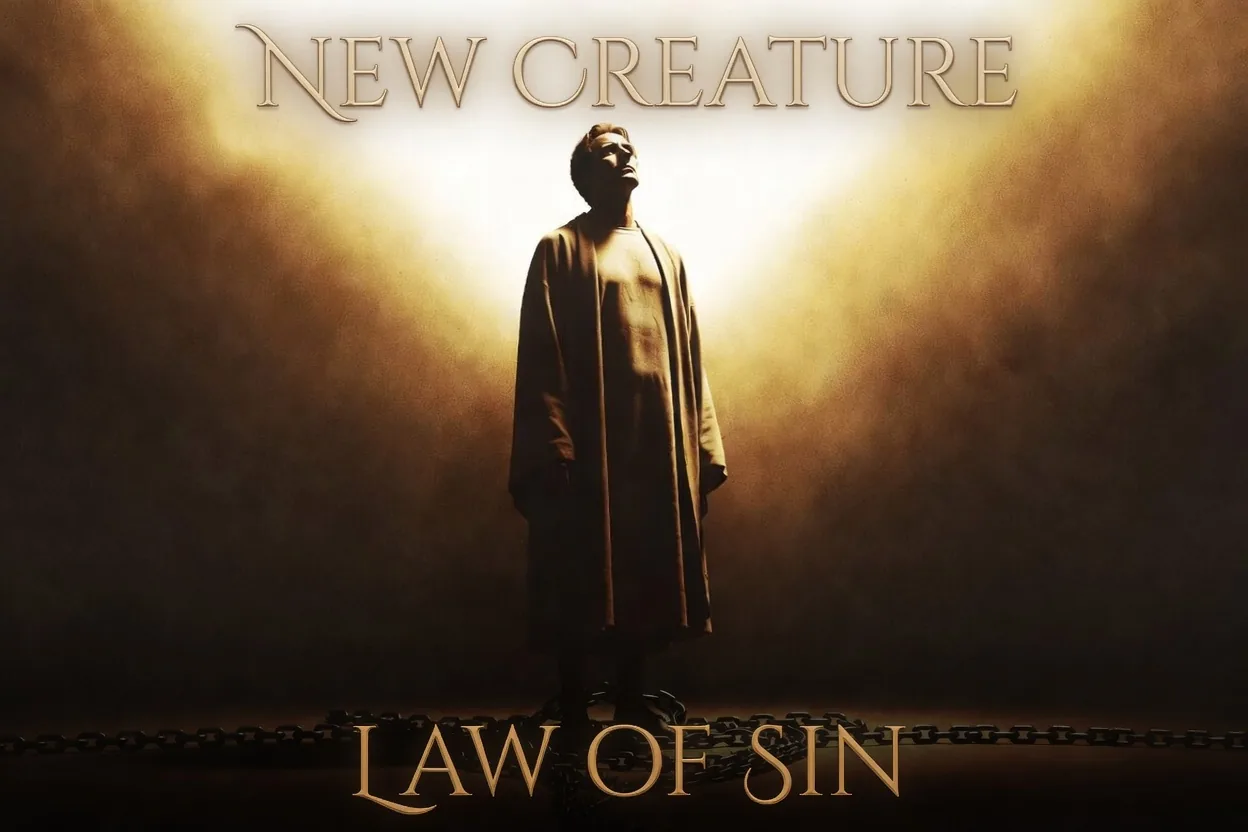
Every honest believer has experienced it. You know what you should do. You genuinely want to do what is right. And yet something in you consistently pulls in the opposite direction. You fail in the very area you most desire to succeed. You find yourself doing what you hate and not doing what you love. You resolve, you commit, you try — and the result is the same.
This is not a sign that you are unsaved. It is not evidence of weak faith or poor character. It is the experience Paul himself described with startling honesty in Romans 7, and it has a name: the law of sin.
Understanding what the law of sin is — and what God has done about it — is one of the most practically liberating truths in Paul's entire body of writing. It explains why willpower and religious effort always fail. It explains what the flesh actually is and why it behaves the way it does. And it reveals why the only answer is not more law but the law of the Spirit of life in Christ Jesus.
What "Law" Means Here
Before defining the law of sin, we need to understand what Paul means when he uses the word law in Romans 7 and 8. He is not always referring to the Mosaic law. In these chapters he uses the word in the sense of a governing principle — a consistent, reliable rule of operation, like a law of nature.
Paul speaks of multiple "laws" in quick succession:
"For I delight in the law of God after the inward man: But I see another law in my members, warring against the law of my mind, and bringing me into captivity to the law of sin which is in my members." (Romans 7:22–23 KJV)
"For the law of the Spirit of life in Christ Jesus hath made me free from the law of sin and death." (Romans 8:2 KJV)
In these verses Paul identifies four distinct laws:
- The law of God — the Mosaic law, which is holy, just, and good (Romans 7:12)
- The law of my mind — the new creature's inner delight in what is right
- The law of sin — the indwelling principle of sin operating in the flesh
- The law of the Spirit of life — the governing principle of the Holy Spirit working in the new creature
The law of sin is not the same as the Mosaic law. It is a spiritual principle — a constant, predictable force operating in fallen human flesh that consistently produces sinful outcomes, just as the law of gravity consistently produces downward motion.
The Law of Sin Defined
Paul introduces the concept gradually through Romans 7. He begins by describing his own experience — an experience every honest person can recognize:
"For I know that in me (that is, in my flesh,) dwelleth no good thing: for to will is present with me; but how to perform that which is good I find not. For the good that I would I do not: but the evil which I would not, that I do." (Romans 7:18–19 KJV)
This is not careless living or deliberate rebellion. Paul says he wills to do good — the desire is genuinely present. But the performance is absent. The flesh does not cooperate with the desire of the inner man. Something in the flesh works against him.
He names it in verse 21: "I find then a law, that, when I would do good, evil is present with me." (Romans 7:21) This is the law of sin in its most concise definition — a governing principle that ensures evil is present whenever the desire to do good arises. It is not random. It is not occasional. It operates as a law — reliably, consistently, without exception — in the unregenerate flesh.
By verse 23, Paul gives it its full title:
"But I see another law in my members, warring against the law of my mind, and bringing me into captivity to the law of sin which is in my members." (Romans 7:23 KJV)
Three things stand out in this verse.
First: it is located in the members. The law of sin is not a demonic force outside the person — it is resident in the flesh, in the body, in the physical members. It is the fallenness of the human nature inherited from Adam. Paul says the same thing in Romans 7:17: "Now then it is no more I that do it, but sin that dwelleth in me." (Romans 7:17) Sin dwells in the flesh as a permanent resident.
Second: it wars. The law of sin is not passive. It actively battles against the law of the mind — the new creature's desire to do right. There is genuine conflict. The Christian life is not a peaceful coexistence between the old nature and the new; it is a war. Paul uses military language deliberately: warring, bringing into captivity. The flesh does not simply resist; it wages campaign.
Third: it brings into captivity. Left to itself — relying only on human effort and willpower — the law of sin wins. It takes the person prisoner. Paul's cry in verse 24 is the cry of a man in chains: "O wretched man that I am! who shall deliver me from the body of this death?" (Romans 7:24) This is not despair about being unsaved. It is the honest recognition that no amount of personal effort can overcome a law. You cannot willpower your way out of gravity. You cannot out-resolve the law of sin.
The Two in Conflict: The Inner Man and the Flesh
To understand the law of sin fully, we need to see what it is fighting against. Paul distinguishes between two realities in the believer:
The inner man is the new creature — the regenerated person, the one created in Christ Jesus (2 Corinthians 5:17; Ephesians 4:24). The inner man delights in the law of God (Romans 7:22). He loves what is right. He is on the side of holiness. This is not a pretense or a religious performance — it is the genuine nature of the new creation.
The flesh is the unregenerate human nature — the fallen physical and soulish nature that was not regenerated at salvation. Salvation gives a new spirit, a new inner man, but the body of flesh remains fallen until glorification. The flesh has not been improved, converted, or sanctified. It is still subject to the law of sin.
Paul describes this duality plainly:
"For that which I do I allow not: for what I would, that do I not; but what I hate, that do I. If then I do that which I would not, I consent unto the law that it is good. Now then it is no more I that do it, but sin that dwelleth in me." (Romans 7:15–17 KJV)
The I that consents to the law and hates evil is the inner man, the new creature. The sin that dwelleth in me is the law of sin operating in the flesh. They are genuinely two different principles at work in the same person. This is why the new creature can hate the sin he commits — it is genuinely against his nature as a new creation, even as the flesh carries it out.
This distinction is not an excuse for sin. It is an accurate anatomy of the human condition in the present age, between regeneration and glorification. The inner man is already complete in Christ (Colossians 2:10); the body of flesh awaits redemption (Romans 8:23). Until that day, the war continues.
Why the Law Cannot Help
Here is the critical misunderstanding that most of Christendom makes: if the law of sin is the problem, then more law must be the solution. If the flesh is sinning, give it stricter rules. Make firmer commitments. Impose heavier accountability. This is the logic of performance-based Christianity — and it is precisely wrong.
Paul explains why in Romans 7:5–6:
"For when we were in the flesh, the motions of sins, which were by the law, did work in our members to bring forth fruit unto death. But now we are delivered from the law, that being dead wherein we were held; that we should serve in newness of spirit, and not in the oldness of the letter." (Romans 7:5–6 KJV)
The motions of sins — the working of the law of sin in the members — were by the law. The Mosaic law did not suppress the law of sin; it agitated it. The reason is stated in Romans 5:20: "Moreover the law entered, that the offence might abound." And in 1 Corinthians 15:56: "the strength of sin is the law."
Law is the strength of sin. When you put a person under law, you do not weaken the law of sin — you energize it. Anyone who has ever tried to defeat a habit by imposing strict rules around it knows this experientially: the rule makes the forbidden thing more compelling, not less. The law of sin feeds on prohibition. It thrives under condemnation.
This is why Paul's answer to the law of sin is never more law. It is never better effort. It is never a new program of self-improvement. He does not say, "I now understand the problem — I will try harder." He says:
"O wretched man that I am! who shall deliver me from the body of this death? I thank God through Jesus Christ our Lord." (Romans 7:24–25 KJV)
The answer is a person, not a program. Deliverance from the law of sin does not come from within the person — it comes from outside, from the Lord Jesus Christ. And the mechanism of that deliverance is described in Romans 8.
The Law of the Spirit of Life
The answer to the law of sin is introduced at the opening of Romans 8:
"There is therefore now no condemnation to them which are in Christ Jesus, who walk not after the flesh, but after the Spirit. For the law of the Spirit of life in Christ Jesus hath made me free from the law of sin and death." (Romans 8:1–2 KJV)
The law of the Spirit of life is a higher governing principle than the law of sin. It does not suppress or discipline the law of sin — it overrides it. The same way the law of aerodynamics can overcome the law of gravity (a wing does not destroy gravity; it applies a greater opposing force), the law of the Spirit of life overcomes the law of sin by the application of a higher and more powerful governing principle.
This freedom is not the freedom to sin carelessly. It is the freedom from the dominion of sin:
"For sin shall not have dominion over you: for ye are not under the law, but under grace." (Romans 6:14 KJV)
Note the direct connection: sin loses its dominion when the person moves from law to grace. Not when they try harder. Not when they make better commitments. When they are not under the law. This is because law is the strength of sin — remove the law as the governing relationship, and the law of sin loses its power source.
The law of the Spirit of life operates through the indwelling Spirit. Paul describes what the Spirit produces in the believer:
"For they that are after the flesh do mind the things of the flesh; but they that are after the Spirit the things of the Spirit. For to be carnally minded is death; but to be spiritually minded is life and peace." (Romans 8:5–6 KJV)
The mind is the battleground. The law of sin operates in the members, but it reaches the behavior through the mind. Walking after the Spirit means setting the mind on the things of the Spirit — occupying the mind with the realities of the new creature's position in Christ, the finished work, the heavenly calling. This is not mysticism; it is what Paul calls being renewed in the spirit of your mind (Ephesians 4:23).
Reckoning: The Believer's Response
Paul does not simply announce the law of the Spirit of life as a theological fact and leave the believer passive. He gives an instruction in Romans 6 that is the practical counterpart to the doctrinal declaration of Romans 8:
"Likewise reckon ye also yourselves to be dead indeed unto sin, but alive unto God through Jesus Christ our Lord." (Romans 6:11 KJV)
Reckon — count it, consider it, treat it as true. The new creature is already dead to sin positionally in Christ. The law of sin still operates in the flesh, but its claim on the new creature has been broken. The believer who reckons this truth — who counts himself dead to sin and alive to God — is applying the law of the Spirit of life. He is living in accordance with what is already true about him in Christ.
This is not positive thinking. It is faith in the Word of God. The reckoning does not make the truth true — the truth is already true in Christ. The reckoning appropriates what is already accomplished.
Paul continues:
"Let not sin therefore reign in your mortal body, that ye should obey it in the lusts thereof. Neither yield ye your members as instruments of unrighteousness unto sin: but yield yourselves unto God, as those that are alive from the dead, and your members as instruments of righteousness unto God." (Romans 6:12–13 KJV)
The members — the very members in which the law of sin dwells — are to be yielded to God rather than to sin. This is the practical outworking of walking after the Spirit. The law of sin has not been removed from the flesh; the believer has simply stopped yielding to it by actively presenting those same members to God.
The Final Answer: Glorification
The law of the Spirit of life is the answer for the present age. But it is not the permanent, final answer. That comes at glorification.
Paul describes it in Romans 8:23:
"And not only they, but ourselves also, which have the firstfruits of the Spirit, even we ourselves groan within ourselves, waiting for the adoption, to wit, the redemption of our body." (Romans 8:23 KJV)
The redemption of our body is the final defeat of the law of sin. When Christ returns and transforms our vile body to be fashioned like His glorious body (Philippians 3:21), the flesh in which the law of sin dwells will be replaced with a glorified body. At that point, the law of sin will have no housing. The war will be over — not because we won it through effort, but because the body that was its battlefield will have been transformed.
Until that day, Paul comforts the believer with the most sweeping declaration in all of Scripture:
"For I am persuaded, that neither death, nor life, nor angels, nor principalities, nor powers, nor things present, nor things to come, Nor height, nor depth, nor any other creature, shall be able to separate us from the love of God, which is in Christ Jesus our Lord." (Romans 8:38–39 KJV)
The law of sin cannot separate you from God's love. It cannot undo your position in Christ. It cannot threaten your standing as a new creature. It can make the present life a battlefield — and it does — but it has no power over your eternal security in the Beloved.
What This Means for the Believer Today
Understanding the law of sin changes how we approach the Christian life entirely.
It removes the shame spiral. When a believer understands that the law of sin is a resident force in the flesh — not a sign of being uniquely wicked or fatally flawed — the shame of failure gives way to honest assessment. The flesh does what the flesh does. The answer is not self-condemnation but the reckoning of Romans 6 and the walk of Romans 8.
It exposes the futility of performance religion. Any system of Christianity that tries to subdue the flesh through stricter rules, more discipline, greater accountability structures, and heavier law-keeping is applying the very thing that strengthens sin. The strength of sin is the law. Grace is not the permission to sin — it is the only environment in which the law of the Spirit of life can operate freely.
It directs attention to the right battleground. The fight is not primarily behavioral — it is mental. Paul says to be spiritually minded, to set the mind on the things of the Spirit, to be renewed in the spirit of your mind. The law of sin reaches the behavior through the mind. The Spirit reaches the behavior through the mind renewed by the Word of God rightly divided. Feed the inner man on Paul's epistles and the law of the Spirit of life will have the fuel it needs.
It anchors security in Christ, not performance. The law of sin will continue to operate in the flesh until glorification. There will be failures. There will be days when the flesh wins the battle. But the new creature's standing before God is not determined by those battles — it is determined by Christ's finished work and the seal of the Holy Spirit. The believer is already accepted in the Beloved (Ephesians 1:6), already complete in Him (Colossians 2:10), already forgiven of all trespasses (Colossians 2:13). The law of sin cannot touch any of that.
"For the law of the Spirit of life in Christ Jesus hath made me free from the law of sin and death." (Romans 8:2 KJV)
Free. Not struggling toward freedom. Not working to achieve freedom. Already free — by the higher law of the Spirit operating in the new creature who is in Christ Jesus. Stand there. Walk there. Reckon it true. And let the law of the Spirit of life do what law-keeping never could.
© 2026 Edward R. Cross








Comments
No comments yet. Be the first to share your thoughts.
Leave a comment