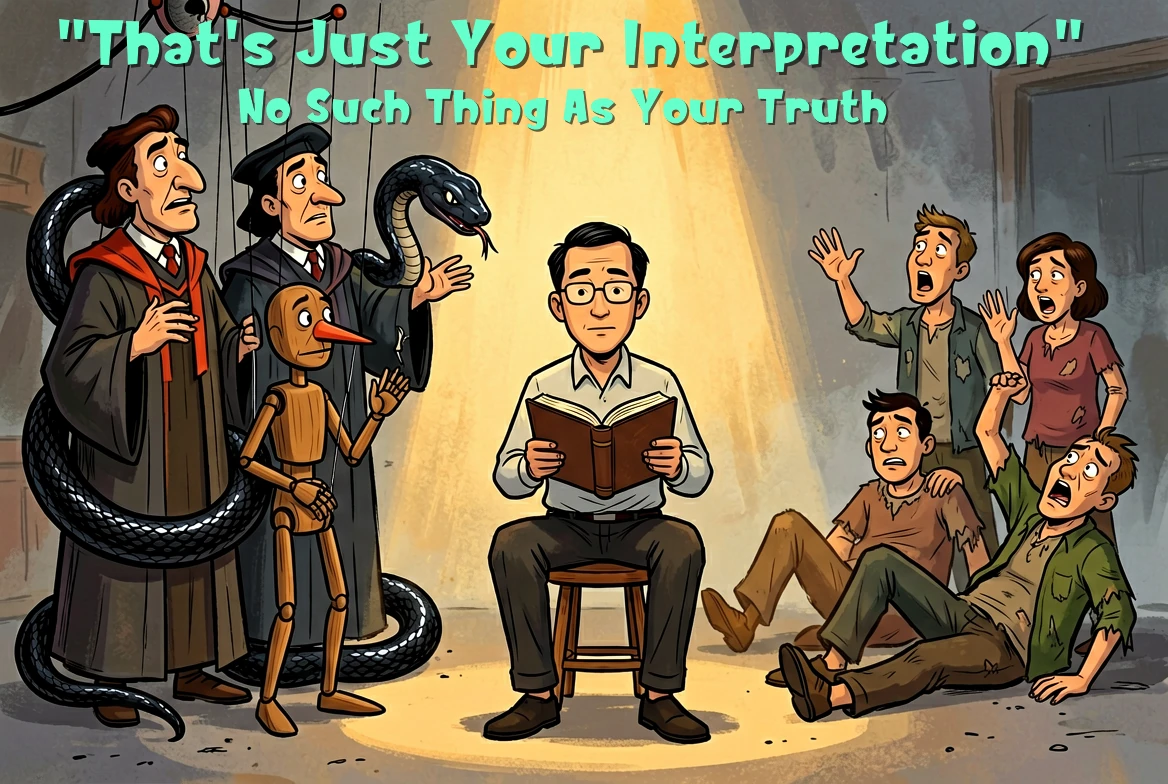
Few objections end a conversation as completely as well, that's just your interpretation. It is offered as though it settled something, and in a sense it does: it makes proof impossible. The one who says it does not answer the text, does not open his Bible to a plainer verse, does not show that the words mean anything other than what they say. He simply demotes the plain statement to an interpretation — one opinion among many — and treats the matter as closed, as though nothing certain had ever stood on the page. It sounds like humility about a hard book. It is nothing of the kind.
The phrase is the last line of defense for a system that cannot answer the text. When the words will not cooperate, tradition does not argue with the words; it demotes them. It turns a plain statement into an interpretation — one opinion among many — calls the fog modesty, and thereby denies, quietly and without ever saying so, that God has spoken anything a man is bound to believe. The objection deserves an answer, because the ruin it leaves behind is not a lost argument but a lost Bible.
The objection is spiritualizing in street clothes
The habit of turning one plain statement into a menu of possible meanings did not begin with the man in the pew. It came down to him from the apostate church, which for centuries taught that Scripture has more than one sense — a literal sense on the ground floor, and above it stacked stories of hidden, higher meanings that only the trained interpreter could reach. Once a verse is allowed to mean four things, a clever man can make it mean a fifth, and there is no plain word left to correct him. That is the whole engine of spiritualizing, and it is the engine still running under that's just your interpretation. The plain words are treated as the ground floor a spiritual man reads past. The real meaning is said to hover somewhere above them, and whoever claims to reach it holds the authority the text was supposed to hold.
The safe rule, recovered when the Bible was handed back to ordinary readers, is the exact opposite: a passage has one interpretation, though it may have several applications. That rule is the ground this whole study stands on, and it is worked out at length in the companion piece on rightly dividing Bible application. But the old error keeps changing clothes. When you hear a man wave off the plain sense with that's just your interpretation, you are not hearing a new argument. You are hearing the medieval upper story rebuilt over your Bible, brick by invented brick. And its oldest form is older than Rome. The serpent's first recorded words are an interpretation argument: "Yea, hath God said, Ye shall not eat of every tree of the garden?" (Genesis 3:1 KJV) He did not deny the word outright. He put it up for discussion.
An uncertain word cannot be obeyed
Here is the ruin the objection leaves behind, and it is worse than a lost argument. If every plain statement is only an interpretation, then nothing God said is certain, and an uncertain word cannot be obeyed. This is not a small inconvenience. It is the death of the thing. Truth that might mean anything commands nothing.
Paul reaches for the plainest picture to say it. "For if the trumpet give an uncertain sound, who shall prepare himself to the battle?" (1 Corinthians 14:8 KJV) A soldier who cannot tell the charge from the retreat stays where he is. An uncertain sound produces an unprepared man — not through rebellion, but because the signal gave him nothing to act on. And the whole of that chapter is God insisting on being understood: "except ye utter by the tongue words easy to be understood, how shall it be known what is spoken? for ye shall speak into the air" (1 Corinthians 14:9 KJV). God did not speak into the air. He is "not the author of confusion, but of peace" (1 Corinthians 14:33 KJV).
Think of what the interpretation argument charges God with. It says the trumpet He gave sounds uncertain — that He commanded a battle and then blurred the signal, that He requires obedience to a word no one can be sure of. That is not reverence. It is an accusation, dressed as humility.
And it runs against everything Paul says the believer is meant to have. Not a guess. Not a leaning. Assurance. "I know whom I have believed, and am persuaded that he is able to keep that which I have committed unto him against that day" (2 Timothy 1:12 KJV). Full assurance — "all riches of the full assurance of understanding" (Colossians 2:2 KJV). Abraham himself is our pattern of it, "being fully persuaded that, what he had promised, he was able also to perform" (Romans 4:21 KJV). A God who deals in full assurance did not leave His word an open question. Uncertainty is not a mark of a deep reader. It is the enemy of the truth, and the truth's enemies have always known it.
The meaning belongs to God, not the reader
Peter is often quoted here, and usually backwards, so read him slowly. "Knowing this first, that no prophecy of the scripture is of any private interpretation" (2 Peter 1:20 KJV). Tradition takes that to mean no private reader may interpret; submit to the church's interpretation. The very next verse dismantles that reading: "For the prophecy came not in old time by the will of man: but holy men of God spake as they were moved by the Holy Ghost" (2 Peter 1:21 KJV). Peter is not talking about who may read the Bible. He is talking about where the Scripture came from. It did not originate in the prophet's own private notions; it came from God, who fixed its meaning at the source. So the verse does not license an interpreting class — it forbids one. The meaning is God's, settled before any reader arrives.
But we do not build the floor on Peter, who wrote to the circumcision. We anchor it in the apostle given to us, who says the same of his own gospel and says it flatly. Paul did not develop his message, negotiate it, or interpret it out of older texts: "For I neither received it of man, neither was I taught it, but by the revelation of Jesus Christ" (Galatians 1:12 KJV). And of his letters he claims no hidden layer for the initiated: "For we write none other things unto you, than what ye read or acknowledge" (2 Corinthians 1:13 KJV). Read equals acknowledge. What you read on the page is the thing itself, with no gap left between the words and the meaning for an interpreter to stand in.
Scripture never offers itself for interpretation — it offers itself to be believed
Notice what the Bible never says about itself. It never presents its meaning as negotiable, never invites the reader to supply a sense, never hangs a true reading above the plain one. It presents itself as light. "The entrance of thy words giveth light; it giveth understanding unto the simple" (Psalm 119:130 KJV). Light is not interpreted; it is seen. Paul preached the same way — not by interpreting the truth but "by manifestation of the truth commending ourselves to every man's conscience in the sight of God" (2 Corinthians 4:2 KJV). To manifest a thing is to show it plainly. The word is handed to us already shown.
Guard this against a fair objection, because the Bible does contain figures. It says so: "Which things are an allegory" (Galatians 4:24 KJV). But mark how Scripture handles its own figures — it flags them, and then it interprets them itself. "The seven stars are the angels of the seven churches: and the seven candlesticks which thou sawest are the seven churches" (Revelation 1:20 KJV). Where the text means a symbol, it says so and tells you what the symbol means. It never leaves the meaning to the reader to manufacture. So the rule holds without exception: God interprets His own figures. He does not appoint you to do it, and He certainly does not open the sense of a plain statement to a show of hands.
There is no such thing as your truth
Follow the objection one step further and it arrives where it was always going: your truth against my truth. Once meaning belongs to the reader, truth becomes a matter of perspective, and every man carries his own. It is worth answering plainly, because it sounds generous and it is deadly.
Perspective is real. Perspective never touches the fact. Two men may stand on opposite shores and see the sun rise over different water; neither one moves the sun. A perspective can change what a man perceives. It cannot change what is. And the moment a thing bends to the one perceiving it, it has stopped being truth and become opinion — for truth, by definition, is what is so whether you see it or not. So your truth is not a humble phrase. It is a contradiction. If it is yours, it is not truth; if it is truth, it is not yours.
Scripture never lets the ownership of truth drift to man. "Let God be true, but every man a liar" (Romans 3:4 KJV). That is the settlement. When God and man disagree, the verdict is fixed before the case is heard — God is true, and the man is the one who is wrong. Truth is not a possession the reader brings; it is a standard he is measured by. "Thy word is truth" (John 17:17 KJV). Not a truth. Not truth for some. The word is truth, and there is no other kind on offer.
The multitude gets no vote on the truth
If truth cannot be made private, neither can it be made by majority. The subjective error has a public twin: not my truth against yours, but our truth — the reading held by the greatest number, the interpretation with the most adherents standing behind it. It wears the look of fairness, even of scholarship: surely the meaning agreed on by the many is safer than the meaning seen by the few. But a count of hands has never once determined what a passage means. Numbers can tell you how many hold a thing. They cannot make the thing true, any more than a single man's perspective could.
Scripture forbids the very instinct outright: "Thou shalt not follow a multitude to do evil; neither shalt thou speak in a cause to decline after many to wrest judgment" (Exodus 23:2 KJV). To decline after many — to bend one's judgment toward the crowd's — is named as the way that wrests the truth, not the way that finds it. The size of an opinion is no evidence for it, and the momentum of a majority is precisely the thing a faithful man is told not to lean into.
And the Bible tests the rule with the clearest case it could choose. At Kadesh, twelve men were sent to see the land, and the report came back split ten to two. The reading of the greatest number was plain and confident: "We be not able to go up against the people; for they are stronger than we" (Numbers 13:31 KJV). Two men saw the same land the opposite way — "Let us go up at once, and possess it; for we are well able to overcome it" (Numbers 13:30 KJV) — and the congregation sided with the ten. The majority carried the vote. The majority was also wrong, and the vote cost a generation the land. Ten against two is a landslide; it was also a lie, and every soul who counted heads instead of believing God died in the wilderness for it.
The apostolic pattern only sharpens it. Under Paul the drift of the many is never toward the truth but away from it. He writes, at the end, that the crowd had already gone: "This thou knowest, that all they which are in Asia be turned away from me" (2 Timothy 1:15 KJV). All of Asia — the consensus — turned from the apostle, and their number did not put them in the right; it only measured the size of the departure. And he tells us the pattern will hold, that men will gather teachers by appetite and settle doctrine by preference: "For the time will come when they will not endure sound doctrine; but after their own lusts shall they heap to themselves teachers, having itching ears; And they shall turn away their ears from the truth, and shall be turned unto fables" (2 Timothy 4:3–4 KJV). That is truth by consensus described to the letter — a majority assembled by what it wants to hear, voting the plain word down and calling the outcome sound. The many are counted here, and they are counted on the wrong side.
So the verdict already given stands against the crowd as fully as against the man alone: "let God be true, but every man a liar" (Romans 3:4 KJV). Every man — one at a time or ten thousand at once. Add the liars together and the sum is not truth; it is only a larger error with more voices behind it. A lie believed by millions is a lie still, and a truth held by one against the world is the truth still. The plain word of God was never submitted to a vote, and it is not waiting on a quorum now.
Every man right in his own eyes was Satan's first sermon
Where does the confidence come from — the notion that a man may settle for himself what a passage means, what is right, what is true? Scripture names its author, and it is not a friend of the reader. It traces back to a single, ruinous idea: that man is fit to be his own judge of truth. Israel's darkest chapter is summed up in it: "In those days there was no king in Israel: every man did that which was right in his own eyes" (Judges 21:25 KJV). No king — no authority over the man but the man. And the result was not liberty. It was the bloodiest, most confused stretch in the nation's history.
That idea has a birthplace. In the garden the serpent first made the plain word uncertain — yea, hath God said — and then offered the prize the interpretation argument still sells: "ye shall be as gods, knowing good and evil" (Genesis 3:5 KJV). To know good and evil for yourself. To be the one who decides. That is the whole offer. Not disobey God, at first, but become your own authority on what is right — and disobedience follows as surely as night. Every that's just your interpretation is a small reenactment of Eden: the plain word questioned, and the self installed as judge in God's place.
Paul saw this exact tactic aimed at the Body of Christ and named it. He feared the believer's mind could be corrupted the way Eve's was — not by open blasphemy but by subtilty, the argument that unsettles the plain word: "But I fear, lest by any means, as the serpent beguiled Eve through his subtilty, so your minds should be corrupted from the simplicity that is in Christ" (2 Corinthians 11:3 KJV). Corrupted from what? Not from cleverness — the serpent has cleverness to spare. From simplicity. The interpretation argument does its damage precisely by making the simple thing seem naive and the fogged thing seem deep. It is the serpent's oldest tool, and it now wears a scholar's robe.
Even a dream that needed interpreting had one true meaning
Someone will press the hard case: but Scripture itself contains things that had to be interpreted — dreams, visions, figures. Doesn't that prove interpretation is real, and open? Grant the case entirely, and it still shuts the door, because every time God gave truth through something that needed interpreting, the interpretation belonged to Him and came out single. There was never a menu.
Joseph settles the principle in one question. Pharaoh's servants were troubled by dreams and had no one to read them, and Joseph does not offer his skill; he names the owner: "Do not interpretations belong to God? tell me them, I pray you" (Genesis 40:8 KJV). Interpretation belongs to God — not to the dreamer, not to the magicians, not to a council. Daniel proves it against a whole guild of professional interpreters who failed, while God gave the one true meaning to His servant: "there is a God in heaven that revealeth secrets" (Daniel 2:28 KJV). And when the meaning is given, Daniel stamps it with the very words the interpretation argument denies to Scripture: "the dream is certain, and the interpretation thereof sure" (Daniel 2:45 KJV). Certain. Sure. Even in the one arena where interpretation was genuinely required, God never produced two right answers. He produced the answer. The idea of many valid interpretations is not found in the Bible from Genesis to Revelation — not even where interpretation is the very subject.
One interpretation, many applications — and neither is a back door to uncertainty
Now the honest reader has a real question, and it must be answered or the whole case is misheard. If a passage has only one meaning, is there no room left to move? There is a great deal of room — but it is governed room, and it never reopens the door this study just shut.
A passage has one interpretation and may have many applications. Those are different things. The meaning is what the words say, and it is fixed. The application is what is rightly done with that fixed meaning — and here is where a single true text reaches many lives, many situations, many days. But application is not a license to reintroduce the fog. It is fenced: an application is legitimate only where an author of Scripture drew it or taught the principle, read at the plain face value of the words. That fence, and the four honest ways a text may be handled, are the whole subject of the companion article on rightly dividing Bible application. Go there for the how.
So too with the tiers of truth a verse may hold — present, dispensational, and universal — worked out in the companion study on present truth, dispensational truth, and universal truth. And this is the point that must not be missed, because it is exactly where a careless reader will think the uncertainty sneaks back in: the types of truth are not subjective, and they are not uncertain. A universal truth is fixed to the unchanging nature of God. A dispensational truth is exactly true, precisely placed, addressed to a particular people. Right division does not blur the truth into perspective. It does the opposite — it tells you exactly which certain word is spoken to whom. That Israel's promises are hers and not ours is not one truth becoming many; it is one truth, rightly located. Rightly dividing the word makes truth more precise, never less. Uncertainty is not the price of careful reading. It is the mark of careless reading, and the interpretation argument is careless reading defended as a virtue.
Answer the words, or admit you cannot
The objection has an answer, and it is not complicated. When a man meets a plain reading with that's just your interpretation, the frame must not be granted, for the frame is the whole trick. He has not answered the text; he has changed the subject from what God said to how a reader happens to see it. The subject must be handed back. Let the passage be opened and let him answer the words — not to say the text could mean something else, but to show from the text that it does. Let him name the word that carries his meaning, and the word that forbids the plain one. Most times, the fog was hiding an empty hand.
And the matter must be settled in a man's own reading as well. The word God gave is not a riddle waiting on anyone's cleverness. It is light, and light is to be walked in. It is a trumpet, and the trumpet is not uncertain. There is no your truth and no my truth — there is the truth, and a man is either standing on it or he is not. The plain word of God is not one opinion among many. It is to be read, believed, and obeyed. That is not arrogance. It is the only honest thing a man can do with a word he has been shown is certain and sure.
© 2026 Edward R. Cross





Comments
No comments yet. Be the first to share your thoughts.
Leave a comment