"For I bear them record that they have a zeal of God, but not according to knowledge. For they being ignorant of God's righteousness, and going about to establish their own righteousness, have not submitted themselves unto the righteousness of God." (Romans 10:2-3 KJV)
Paul wrote those words about his own nation. Israel had a zeal for God that was real, fervent, and sincere — and aimed at the wrong righteousness. It is at once the most charitable and the most searching thing that can be said of a religious movement: the zeal may be genuine and the direction still wrong. Both are worth saying about the revival now gathering on the nation's campuses, because both are true, and because the people caught up in it deserve to be taken seriously enough to be told the truth rather than flattered with it.
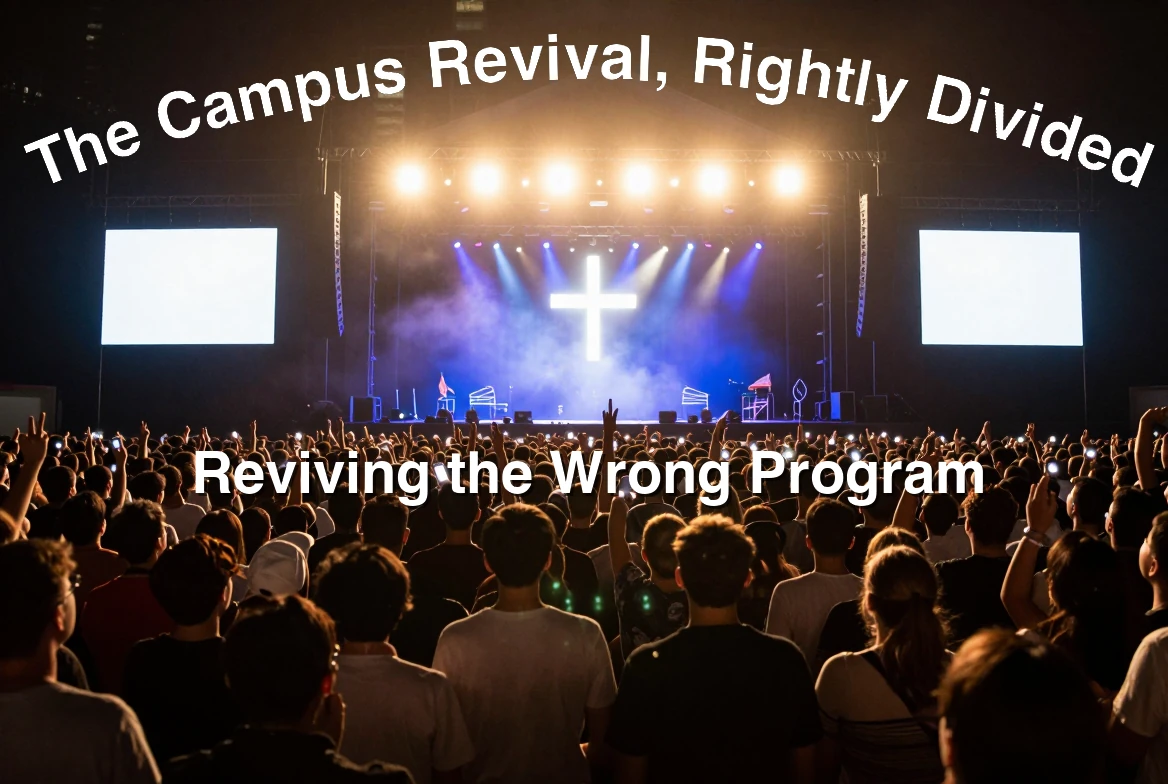
A revival is being announced across the country — filled arenas, mass professions of faith, a surge of interest online, and a summons to take the nation back for God under the banner of faith and freedom. Some of it is stirred by charismatic leadership, some by public emotion, and some, no doubt, by a real hunger for something more than the age is offering. It would be both false and unkind to say that no one in this has met the living God; wherever the actual gospel of Christ is preached and believed, God saves, and no cultural packaging on earth can stop Him. But a revival must be measured by what it revives, and when the thing is laid against the rightly divided word, what is being called a revival of the gospel proves to be, in the main, something else wearing the gospel's name. This is a companion to The False Gods Worshipped in Churches, and it is the same pattern that article traced — the true God's name proclaimed over an image the culture has built — now unfolding at national scale in our own moment. What is being revived is not, for the most part, the gospel of the grace of God. It is American civil religion: the renewal of a nation's morale, morality, and identity under the name of Christ.
First, What a Revival Is — and Whose It Was
Begin with the word, because it is carrying more freight than anyone notices. Revival is an Old Testament, covenant-nation idea. It is Israel, a people who had God's law and strayed from it, being brought back: "Wilt thou not revive us again: that thy people may rejoice in thee?" (Psalm 85:6 KJV); "O LORD, revive thy work in the midst of the years" (Habakkuk 3:2 KJV). The verse every revival movement leans upon is the same shape: "If my people, which are called by my name, shall humble themselves, and pray, and seek my face, and turn from their wicked ways; then will I hear from heaven, and will forgive their sin, and will heal their land" (2 Chronicles 7:14 KJV). Spoken to Solomon, it has a covenant, a temple, a land, and a covenant people to revive. Every term of it belongs to national Israel.
America is none of those things. It is a Gentile nation with no covenant to renew, no divine promise to reclaim, no land that God has bound Himself to heal on terms of national repentance. To pray for a God-centered revival of the nation as though the republic stood where Israel stood is to borrow a promise God never made to it. And the Body of Christ, for its part, is never once commanded to seek revival. Our word is different and quieter: "be renewed in the spirit of your mind" (Ephesians 4:23 KJV) — an inward, individual, doctrinal renewing, one believer at a time, by the truth. The moment "revival" comes to mean the moral and cultural restoration of a nation, it has left Paul's program altogether and stepped back into Israel's, where the promises it is quoting actually live.
Back to Sinai: The Sabbath and the Decalogue
Nothing shows the wrong program more plainly than where this revival turns for its rule of life. Alongside the call to reclaim the nation has come a summons back to the Sabbath, and it is pressed with real force. American Christians are scolded for neglecting the day; the fourth commandment is held up as the most ignored of the Ten and the very hinge on which obedience to the other nine turns; and the argument is made blunt — if you believe the first verse of the Bible, that God made the world and rested on the seventh day, then you are bound to keep it. The whole Decalogue, on this telling, is binding on the believer still, a creation ordinance owed by everyone who believes in the Creator, and the West is called back to Sinai to recover it. The impulse to cease striving is not wrong, and much that is said about a frantic and exhausted culture is true. But the doctrine underneath it is Israel's, not the Body's, and Scripture is not vague about the difference.
The Sabbath is a sign, and it names the exact party it was given to: "Verily my sabbaths ye shall keep: for it is a sign between me and you throughout your generations" (Exodus 31:13 KJV), "a sign between me and the children of Israel for ever" (Exodus 31:17 KJV). Not a sign for mankind at large, but for the nation Israel — God says it twice in one chapter, and again through the prophet: "I gave them my sabbaths, to be a sign between me and them" (Ezekiel 20:12 KJV). And to the Body of Christ Paul could not be more direct; he forbids the very judgment the Sabbath revival invites. "Let no man therefore judge you in meat, or in drink, or in respect of an holyday, or of the new moon, or of the sabbath days: Which are a shadow of things to come; but the body is of Christ" (Colossians 2:16-17 KJV). Two verses earlier he had said what became of that whole code of ordinances — it was "Blotting out the handwriting of ordinances that was against us... nailing it to his cross" (Colossians 2:14 KJV). On the calendar the believer stands in liberty, not obligation: "One man esteemeth one day above another: another esteemeth every day alike. Let every man be fully persuaded in his own mind" (Romans 14:5 KJV). And when the Galatians began to keep days, Paul did not applaud their zeal — he feared for them: "how turn ye again to the weak and beggarly elements, whereunto ye desire again to be in bondage? Ye observe days, and months, and times, and years. I am afraid of you" (Galatians 4:9-11 KJV). We "are not under the law, but under grace" (Romans 6:14 KJV).
So here is the whole thesis compressed into a single turn: a movement summoning the nation to revival, reviving the one institution God expressly stamped as Israel's sign, re-shelving the Ten Commandments as binding law, and calling the West back to Sinai. That is not a revival of the gospel of the grace of God; it is a return to the shadow after the substance has already come. The believer's rest was never a day at all. It is a Person: "ye are complete in him" (Colossians 2:10 KJV), and the shadow's substance, Paul says, "is of Christ" (Colossians 2:17 KJV). (For the fuller treatment, see No Such Thing as a Christian Sabbath or Holy Day*.)*
Faith and Freedom: A Gospel With a Nation Added
The movement states its own aim plainly. Its banner is faith and freedom; its call is to put faith into action and to defend God-given rights. Whatever else that is, it is a gospel with something added — Christ plus a country, Christ plus a liberty, Christ plus a cultural cause. Paul's response to any gospel-plus is not measured, and it is not partisan; it is absolute: "But though we, or an angel from heaven, preach any other gospel unto you than that which we have preached unto you, let him be accursed" (Galatians 1:8 KJV). The gospel of the grace of God is "how that Christ died for our sins according to the scriptures; And that he was buried, and that he rose again the third day" (1 Corinthians 15:3-4 KJV) — believed. It produces citizens whose "conversation is in heaven" (Philippians 3:20 KJV), people already "translated... into the kingdom of his dear Son" (Colossians 1:13 KJV), not activists commissioned to reclaim an earthly one.
This is where right division does the decisive work. There is a political, national, earthly kingdom in the Scriptures — but it is Israel's, and it belongs to a coming age, not to this one. The attempt to build a Christian nation now, to legislate the land back to God, is Israel's kingdom hope smuggled into the Body's heavenly calling — and it reaches for weapons the Body was never given: "For though we walk in the flesh, we do not war after the flesh: (For the weapons of our warfare are not carnal, but mighty through God to the pulling down of strong holds;)" (2 Corinthians 10:3-4 KJV). A culture war is carnal warfare, however spiritual its vocabulary. And lest this be mistaken for a complaint against one political side, it is not: the identical error runs on the left, where the gospel is fused to a program of social and political liberation, and it is the same idol there, only facing the other way. A gospel wedded to any earthly cause, right or left, has already ceased to be the gospel of the grace of God.
A Communion With No Creed
By its own description the movement has no doctrinal creed, and it unites believers of contradictory theologies under a single banner of faith. Set aside for a moment whether any given participant is a believer, and weigh only what such a coalition can and cannot be. It cannot be a revival of the gospel, because it has formally declined to say what the gospel is. Its unity is real, but it is unity around a cultural and political cause, not around the faith once delivered — and a faith that will not define itself has already conceded that its content is negotiable. This is precisely the danger Paul named: a message men "well bear with" because it asks nothing of their doctrine — "another Jesus, whom we have not preached... another spirit... another gospel" (2 Corinthians 11:4 KJV).
It is worth being exact here. The problem is not that any one leader preaches a gospel of works. The problem is that a movement which sets the gospel of faith alone and a gospel of faith-plus-merit side by side under one creedless banner has treated the difference between them as beneath mention — and that difference is the entire matter. Paul stakes everything on the one article a creedless coalition cannot afford to leave open — that a man is justified "not... by the works of the law, but by the faith of Jesus Christ... for by the works of the law shall no flesh be justified" (Galatians 2:16 KJV); "Therefore we conclude that a man is justified by faith without the deeds of the law" (Romans 3:28 KJV); "to him that worketh not, but believeth on him that justifieth the ungodly, his faith is counted for righteousness" (Romans 4:5 KJV); "by grace are ye saved through faith... not of works, lest any man should boast" (Ephesians 2:8-9 KJV). And the saving thing is not the strength or the persistence of a man's own believing, as though faith were a work he must keep up; it is the finished work of Christ, trusted and rested in — the faith of Christ, and not a righteousness of one's own. A revival that will not say whether a man is saved by resting in that finished work alone, or by that work plus his own merit, has not revived the gospel. It has quietly agreed to stop asking the question on which the gospel stands.
On the faith of Christ — His own faithfulness, not the strength of the believer's believing, as the ground of justification — see The Mystery of Faith, Part 1 and Part 2.
A Fire Kindled by a Man
Then there is the engine of the surge, and it is the plainest tell of all. A revival of this kind rallies around a personality and is intensified by public emotion; its arenas fill, its network of churches is reported to have doubled in a matter of weeks, its new believers are counted by the hundred thousand, and its reach online multiplies many times over. All of it is offered as proof that God is in it. But a crowd is not a verdict, and its testimonies run not to the finished work of Christ but to a man — he re-inspired my faith; I'm going back to church. Take the politics out of it completely and that sentence is still the problem, because the reviving agent it names is a man. That is the exact carnality Paul rebuked at Corinth, where the church had begun to rally around its favorite personalities: "Is Christ divided? was Paul crucified for you?" (1 Corinthians 1:13 KJV); "for while one saith, I am of Paul... are ye not carnal?" (1 Corinthians 3:4 KJV). The flesh has always loved a champion, and public feeling is one of the strongest currents that moves through a crowd — but feeling is not the gospel, and inspiration drawn from an admired man is not regeneration. Paul was blunt about where a saving faith must rest: "That your faith should not stand in the wisdom of men, but in the power of God" (1 Corinthians 2:5 KJV). It is "the gospel of Christ... the power of God unto salvation to every one that believeth" (Romans 1:16 KJV) — the power is in the message received, not in the fervor of a moment. A revival counted in streams and stadiums is measuring the one thing that proves nothing.
And the size of the thing is exactly what is being offered as its proof — which is to read the wrong instrument entirely. Scripture never makes wide acceptance the test of truth; it warns of the opposite, a day when men "will not endure sound doctrine; but after their own lusts shall they heap to themselves teachers, having itching ears" (2 Timothy 4:3 KJV). The congregation does the heaping, and the size of the crowd measures only the appetite that gathered it. To watch the numbers climb and conclude that God must therefore be in it is the old error Paul named — "supposing that gain is godliness" (1 Timothy 6:5 KJV) — mistaking increase for approval. A message the natural man welcomes by the hundred thousand should prompt the question Paul forces, not silence it: is this the gospel he preached, or another the flesh will always bear with?
The same misplacement shows even in the movement's instinct toward forgiveness, admirable as that instinct is. When forgiveness is grounded in imitating an example — doing what a good man would do, or reenacting a scene — it has reached for the wrong foundation. The believer in this dispensation does not forgive in order to copy a model; he forgives out of a forgiveness already finished and already his: "be ye kind one to another, tenderhearted, forgiving one another, even as God for Christ's sake hath forgiven you" (Ephesians 4:32 KJV); "even as Christ forgave you, so also do ye" (Colossians 3:13 KJV) — because he has already been "forgiven... all trespasses" (Colossians 2:13). We forgive from forgiveness, never toward it. There is a forgiveness in Scripture conditioned on our forgiving others — "But if ye forgive not men their trespasses, neither will your Father forgive your trespasses" (Matthew 6:15 KJV) — but it is kingdom ground, spoken to Israel under terms, and to move it into the age of grace is to turn the finished work of Christ into a work of our own.
Awakened, but to What?
There is a subtler mark of this revival, and it outlasts the crowds. The people it sweeps up come away certain they have been awakened — that they now see, that they stand on the side of light in a dark age. But look at what actually changed in them. The moral vision they carry is, in the main, the culture's own: its traditions, its politics, its respectable instincts about what a decent life looks like, now wrapped in the language of faith and worn with the confidence of the enlightened. Little of it was ever laid against Scripture and weighed; little of it came out of the rightly divided word at all. That is not the renewal the Body of Christ is promised. Paul's command is not that a man exchange one cultural allegiance for a more religious one, but that he "be not conformed to this world: but be ye transformed by the renewing of your mind" (Romans 12:2 KJV) — transformed by the word, at the level of the mind, until the walk answers to Christ and not to the culture, whether the culture is calling from the left or the right. A revival that leaves a man conformed to the world's norms while convinced he has been enlightened has renewed his loyalties, not his mind.
And the certainty itself is worth pausing over, because it is an old symptom of the wrong kind of knowledge. "Knowledge puffeth up", Paul says, and "if any man think that he knoweth any thing, he knoweth nothing yet as he ought to know" (1 Corinthians 8:1-2 KJV). The man most sure he has stepped into the light is often the man least willing to test it — and the light of this age is exactly the thing Scripture says to test, for the enemy who blinds the world does his finest work disguised: "Satan himself is transformed into an angel of light" (2 Corinthians 11:14 KJV). To feel enlightened is not to be in the light. The only light that does not deceive is the glorious gospel of Christ, believed and rightly divided; every other dawn is borrowed from the age that is passing away.
The same borrowed light shows in what this revival will and will not call sin. Where the age has renamed a sin a mere life choice, the professed believer — anxious to give no offense, to be thought loving and tolerant — adopts the new name and lets the matter drop, and calls that grace. But the whole aim is to take away an offense, and Paul tells us which offense goes with it. When a message stops offending, it is because the cross has been taken out of it: "then is the offence of the cross ceased" (Galatians 5:11 KJV). And there is the plain test: if the offense is gone, it cannot be the gospel Paul preached — for the offense was never a flaw in that gospel to be filed off; it was the cross standing at its center, the one thing the world was always going to stumble at. Remove what the world stumbles at and you have removed the cross, and a message with no cross in it is not the gospel of Christ, whatever name it keeps. Grace never asked for the sin to be renamed; it met the sin as sin and answered it there. To relabel what God condemns so that no one need take offense, and nothing need be called sin, is neither enlightenment nor love. If we are honest about the motive, it is usually the old fear Paul exposed in the men who trimmed their message "lest they should suffer persecution for the cross of Christ" (Galatians 6:12 KJV). A servant of Christ cannot both please men and serve his Lord — "if I yet pleased men, I should not be the servant of Christ" (Galatians 1:10 KJV) — and the promise to the Body of Christ runs the opposite way from the safety being bought: "all that will live godly in Christ Jesus shall suffer persecution" (2 Timothy 3:12 KJV). A revival that keeps a man comfortable with the world by agreeing with the world about sin, giving no offense and taking none, has revived nothing; it has only negotiated a truce with the age at the cross's expense. That is not revival.
What a Real Revival Would Look Like
If the Body of Christ could be "revived" in any sense proper to it, it would not look like a nation stirred. It would look like individuals hearing the gospel of the grace of God and believing it, and like believers already saved being renewed in the spirit of their minds by the rightly divided word until they walked worthy of it. Its measure would be truth held, not crowds gathered; its permanence would come from sound doctrine, which the surge now underway cannot supply to the people it is sweeping in. And it would send those believers out — not into the fortress of withdrawal, and not into conformity with the world, but into the world as they are, unspotted and unashamed, holding the office Paul says we hold: "Now then we are ambassadors for Christ, as though God did beseech you by us: we pray you in Christ's stead, be ye reconciled to God" (2 Corinthians 5:20 KJV).
That is the difference between a revival of the truth of the gospel and a revival of a nation's religion. One turns men to God; the other turns a culture to itself and hangs the name of Christ above the door. Israel had a zeal of God, and it was not according to knowledge, and it left them establishing a righteousness of their own instead of submitting to His. The kindest and the truest thing we can do for a generation caught up in a fervor it has been told is the gospel is to hand it the gospel — and to teach it, as Thessalonica was taught, what it actually means to have "turned to God from idols to serve the living and true God" (1 Thessalonians 1:9 KJV).
© 2026 Edward R. Cross



Comments
No comments yet. Be the first to share your thoughts.
Leave a comment